
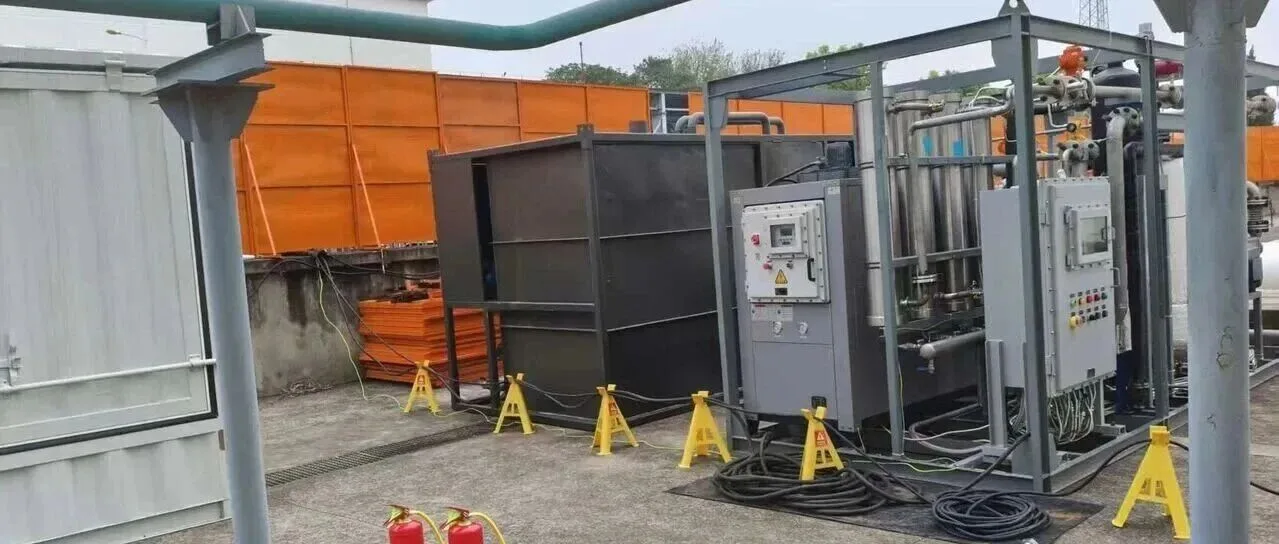
In mechanised storage tank cleaning projects, whether equipment can adapt to the site conditions of different tanks directly affects its practical value.
For refined-product tanks, chemical storage tanks and small crude oil tanks at oilfields with capacities below 10,000 m³, tank capacity, internal structure, stored media and site working conditions can all vary.
The design of small-scale mechanised cleaning equipment therefore needs to address not only cleaning itself, but also how the equipment enters the tank, how it is positioned and how the operating method can be adjusted to actual conditions inside.
What features does a mechanised cleaning system suitable for small and medium-sized tanks need?
01 Applications: Different Types of Small and Medium-Sized Tanks
Tecway Industrial's in-house-developed small-scale mechanised cleaning equipment is primarily intended for tanks below 10,000 m³.
Applications include:
Refined-product storage tanks, such as tanks for petrol, diesel and aviation kerosene;
Chemical storage tanks, commonly with capacities below 5,000 m³;
Small crude oil storage tanks, primarily for oilfield applications.
Among these, internal floating-roof tanks are a particular focus.
02 Entry Through a Manway: Reducing Complex Equipment Arrangements
For small and medium-sized tanks, the available space on site and the way equipment is brought in are important considerations in mechanised cleaning.
The equipment supplied by Tecway allows cleaning guns to be positioned through a tank manway, reducing reliance on complex lifting operations from the tank roof.
This arrangement enables the equipment to adapt more flexibly to different site conditions and offers another option for some tank projects with limited working space.
03 Visual Operation: Seeing Conditions Inside the Tank
Once the equipment has entered the tank, how can operators understand the actual conditions inside?
Tecway's equipment incorporates a camera for visual cleaning. Operators can observe conditions inside the tank on screen and identify areas requiring particular attention based on sludge distribution and cleaning progress.
Compared with relying entirely on a preset operating method, visual observation can provide more practical information for on-site operation.
Seeing conditions clearly is the basis for targeted cleaning.
04 Flexible Adjustment: A Cleaning Gun That Rotates Through 360°
Sludge deposits are not distributed evenly inside a tank, and different locations may require different cleaning directions.
To address this need, the equipment uses a nozzle designed for 360° rotation, allowing the cleaning direction to be adjusted to actual operating requirements.
Combined with camera observation of the tank interior, operators can adjust the working position to actual cleaning needs, extend cleaning coverage and reduce missed areas.
05 Equipment Configuration: Determined by Project Conditions
Having the relevant functions does not mean that every project can use exactly the same configuration.
Before cleaning begins, the following information also needs to be understood:
Tank capacity and structural design;
The media previously stored;
Sludge and deposits on the tank bottom;
Manway locations and conditions for equipment positioning on site;
The project schedule and specific cleaning requirements.
This information is needed to determine the equipment configuration and work execution plan.
For tanks of different types and under different operating conditions, matching the equipment and cleaning plan to the project helps make better use of mechanised cleaning.