In mechanised tank cleaning, getting the equipment into the tank is only the first step. Another issue that is easily overlooked also has a real impact on cleaning results:
Once inside the tank, can the equipment cover the areas that need cleaning?
Sludge and deposits at the bottom of a storage tank are not necessarily distributed evenly. Deposit conditions, cleaning difficulty and internal structures can all vary from one location to another. If the working direction and range of the cleaning equipment are restricted, some areas may already be cleaned while others still require further treatment. So, beyond the working capability of the cleaning equipment itself, whether the cleaning gun can flexibly adjust its direction also deserves attention.
01 Why Do Dead Zones Occur So Easily?
The inside of a storage tank is not a completely open, structurally simple space. In some small and medium-sized tanks in particular, sludge at the tank bottom may be concentrated locally or vary in thickness; some tanks also contain floating-roof support legs and other structural members that affect equipment layout and cleaning coverage.
In this environment, if the cleaning gun can only work in a relatively fixed direction, it may be difficult to cover different locations adequately. For localised deposits that need focused treatment in particular, continuous cleaning in a fixed direction alone may not meet actual requirements.
Enabling the cleaning gun to adjust its working direction flexibly according to conditions inside the tank is an important part of reducing cleaning dead zones.
02 360° Rotation for Greater Directional Flexibility
To address this issue, the mechanised cleaning equipment provided by Tecway features a cleaning gun nozzle that can rotate through 360°.
Compared with cleaning methods whose working direction is restricted, a nozzle that can rotate through 360° gives the cleaning equipment more flexibility in adjusting direction. When sludge has accumulated in different locations, the nozzle direction can be adjusted according to actual cleaning needs, allowing the cleaning operation to cover more areas.
The value of this design is not simply the addition of a rotation function, but that it allows the cleaning gun to better adapt to cleaning needs at different locations inside the tank.
With more flexible cleaning directions, there is also more room to adjust the equipment's working coverage.
03 Seeing Clearly Shows Where to Clean
Once the cleaning gun can adjust its direction, operators also need to know where it should be aimed. This is why visualisation is so important in mechanised cleaning.
By observing actual conditions inside the tank through a camera, operators can understand sludge distribution and the current cleaning status, then use the cleaning gun's directional adjustment capability to carry out targeted cleaning of areas that need focused treatment.
The overall process is:
Observe conditions inside the tank → Determine the cleaning location → Adjust the nozzle direction → Carry out targeted cleaning.
In this way, cleaning no longer depends entirely on a preset fixed direction, but can be adjusted according to actual conditions inside the tank.
Visualisation shows "where cleaning is needed", while nozzle rotation determines "how to adjust the direction".
Together, they make mechanised cleaning more targeted.
04 What Else Needs to Be Considered to Reduce Dead Zones
In tank cleaning, the flexibility of the cleaning gun is only one part of how well the equipment adapts. In actual projects, the following also need to be considered together:
Internal tank structure: Different tank types have different internal components, so equipment layout and cleaning coverage need to be considered according to actual conditions.
Sludge deposit conditions: The degree of deposition may vary between locations, so the areas requiring focused treatment need to be determined according to site conditions.
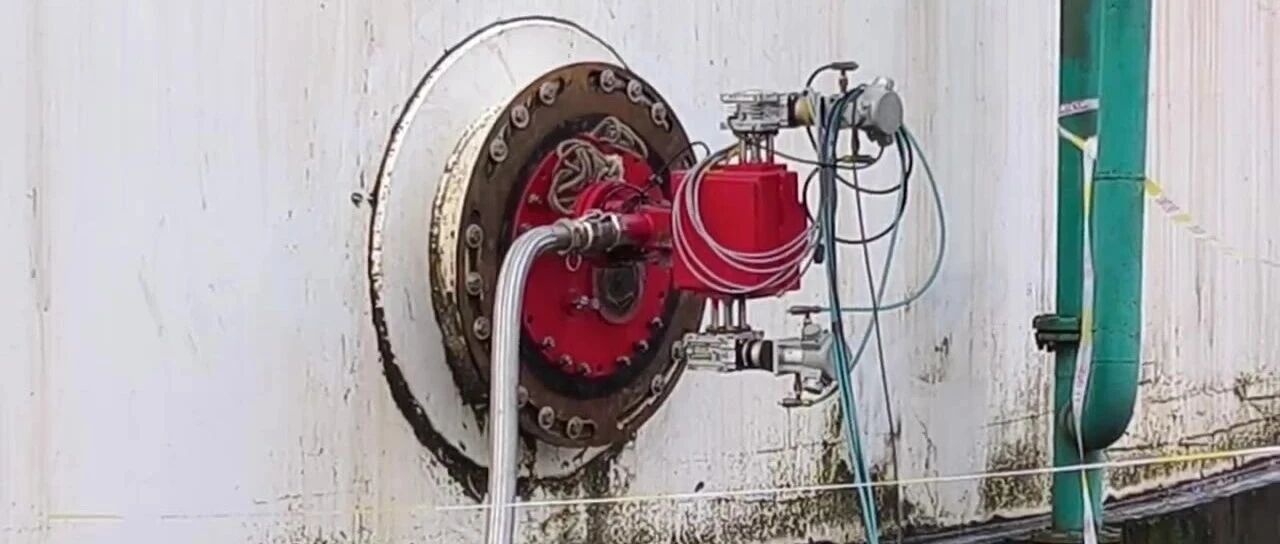
Equipment layout: After the cleaning gun enters through the manway, equipment position and working direction need to be arranged according to site conditions.
Therefore, reducing cleaning dead zones cannot be achieved by relying on any single component alone; it is the combined result of equipment design, site layout and cleaning process. For mechanised cleaning, truly valuable equipment design is design that can be adjusted flexibly to actual working conditions, rather than only completing work according to a fixed pattern.
05 Bringing Cleaning Closer to Actual Working Conditions
From manway entry, to camera visualisation, to 360° rotation of the cleaning gun, the design approach of mechanised cleaning equipment for tanks below 10,000 m³ has always centred on one core idea: making the equipment better suited to the actual working environment inside the tank.
A cleaning gun that can adjust its direction flexibly, combined with visual observation and targeted cleaning, helps expand working coverage and reduce localised omissions and cleaning dead zones. Of course, the final cleaning result still needs to be assessed comprehensively in light of tank type, sludge condition, equipment configuration and the specific work plan.
The value of the equipment lies not only in being able to enter the tank, but in being able to work flexibly according to actual conditions once inside. Sludge distribution and cleaning status inside the tank are visible on the screen.