

Introduction
Previously, shipowners' carbon compliance concerns were mainly concentrated in international or regional schemes such as the EU ETS, FuelEU Maritime, the UK ETS and the IMO's global emissions reduction mechanism. Today, some African countries have also begun bringing international maritime emissions into their national carbon management systems, exploring new cost requirements for shipping activities through carbon contributions, carbon offsetting and other approaches. The carbon compliance landscape for international shipping is changing.
In July 2026, Gabon formally incorporated maritime and aviation carbon contribution provisions into its revised finance law. During COP31 in November, Guinea signed a carbon market cooperation agreement with Djibouti, planning to draw on Djibouti's sovereign carbon management experience to develop its own carbon registry and carbon market institutions.
CARBON COMPLIANCE · 01
Djibouti: An Early Adopter of a Carbon Contribution Mechanism
Djibouti is one of the earlier African countries to establish a sovereign carbon contribution mechanism.
In March 2023, Djibouti adopted Decree No. 2023-074/PRE, formally establishing the Sovereign Carbon Initiative and creating a Sovereign Carbon Contribution mechanism and national carbon registry.
Based on the “polluter pays” principle, the mechanism brings greenhouse gas emitters in aviation, maritime and other sectors operating in or transiting through Djibouti within its scope. The related funds support environmental protection, energy transition and climate adaptation projects.
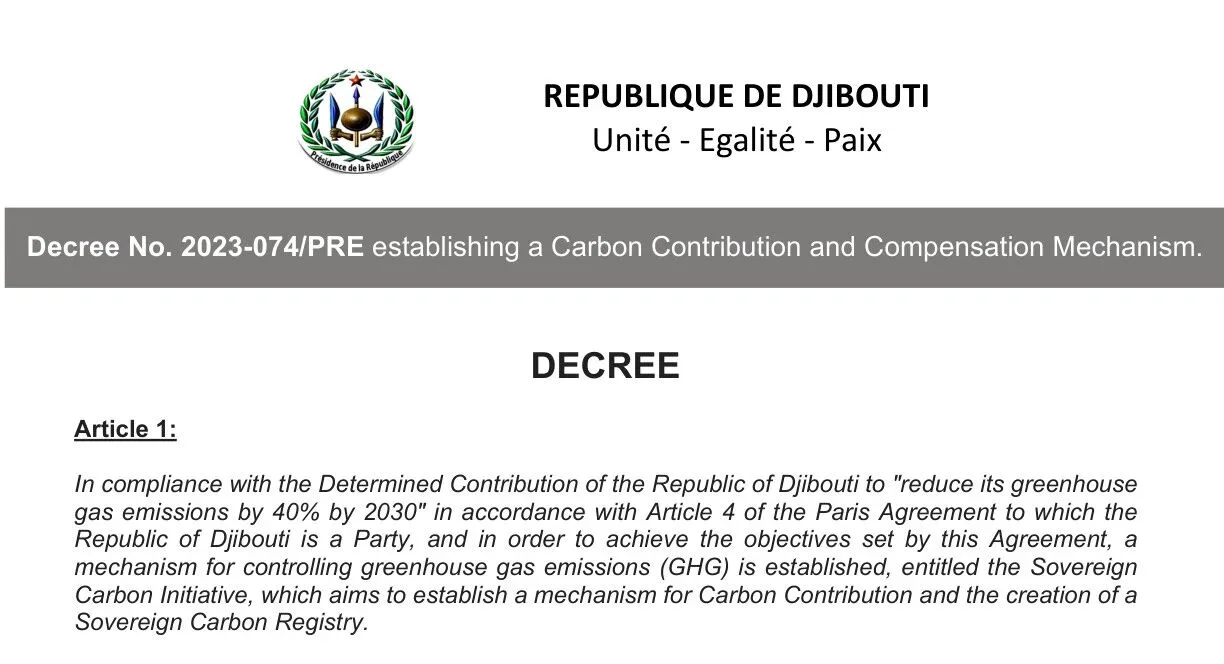
Djibouti Presidential Decree No. 2023-074/PRE: Establishing a sovereign carbon contribution and compensation mechanism (official English translation)
For the shipping industry, several features of Djibouti's mechanism merit attention:
1. Scope
Under the rules of Djibouti's sovereign carbon registry, vessels calling at Djibouti ports and completing the relevant customs and port clearance formalities are, in principle, required to report their voyage information and associated carbon emissions data.
As the vessel's legal representative for port affairs, the ship agent is responsible for the relevant voyage reporting and implementation of mitigation obligations.
2. Emissions Calculation Scope
Djibouti uses a voyage emissions allocation approach. For voyages between Djibouti ports and foreign ports, 50% of emissions are allocated to Djibouti, with the remaining 50% allocated to the country at the other end of the voyage.
Emissions can be calculated from the vessel's actual fuel consumption or estimated with reference to vessel type, voyage distance and the corresponding emission factors.
3. Carbon Contribution Standard
According to Version 2 of the sovereign carbon registry rules published by Djibouti in August 2024:
- Carbon contribution price: $17/tCO₂e;
- The carbon contribution for an individual vessel voyage is capped at $7,500;
- From July 1, 2025, the mitigation obligation was adjusted to 70% carbon contribution and 30% carbon offsetting, with the offset portion subject to the relevant requirements for local carbon credit projects.
The rules also provide that vessels with DWT below 3,000 tonnes, GT below 500 tonnes, container capacity below 300 TEU, as well as vessels flying the Djibouti flag, may receive exemptions from the relevant reporting and mitigation obligations.
Djibouti has therefore established a relatively complete management framework covering voyage reporting, emissions accounting, carbon contributions and carbon offsetting.
CARBON COMPLIANCE · 02
Gabon: Carbon Contributions Incorporated into Fiscal Law
Compared with Djibouti, Gabon's latest policy development merits particular attention from shipping companies.
On July 17, 2026, Gabon published Law No. 002/2026, the revised finance law for 2026. Article 6 amended the carbon contribution provisions in the existing finance law, explicitly establishing a carbon contribution mechanism for economic operators in the maritime and aviation sectors.
Under the law, the mechanism is intended to incorporate the cost of the relevant greenhouse gas emissions into operators' economic activities and provide funding for environmental protection, energy and ecological transition projects.
The specific provisions include:
1. Covered Operators
Economic operators in the maritime and aviation sectors are both covered by the carbon contribution mechanism.
For the maritime sector, the provisions apply to vessel voyages between Gabonese ports and foreign ports.
2. Emissions Accounting
Gabon applies the principle of allocating 50% of voyage emissions.
Of the emissions generated by a vessel travelling between a Gabonese port and a foreign port, 50% are treated as carbon emissions associated with Gabon, while the other 50% are allocated to the country at the other end of the voyage.
The relevant emissions are determined using simulation calculation tools, with calculation methods referencing accounting methods and emission factors recognised by the International Maritime Organization (IMO) and other international organisations.
3. Carbon Contribution Rate
The law explicitly specifies: 21,400 FCFA/tCO₂.
4. Vessel Exemptions
The following vessels may receive an exemption from the carbon contribution:
- Vessels with DWT below 2,000 tonnes;
- Vessels with GT below 400 tonnes;
- Container ships with container capacity below 200 TEU;
- Vessels flying the Gabonese flag.
5. Payment Responsibility and Administration
The Gabon Green Economic Development Agency (AGADEV) is responsible for calculating and administering the relevant carbon contributions.
Under the law, AGADEV will invoice maritime operators on a per-vessel basis. The calculation results are recorded in Gabon's sovereign carbon registry and subject to independent verification.
Notably, the law explicitly states that the carbon contribution is borne by the relevant maritime and aviation economic operators and cannot be passed on to other parties.
This means vessel operators need to incorporate the relevant carbon contribution into their operating cost assessments and monitor the specific reporting, invoicing and payment procedures to be published by the competent authorities.
CARBON COMPLIANCE · 03
Guinea: Carbon Offset Mechanism Under Study
Guinea is another country meriting attention in recent African carbon market policy discussions.
On October 12, 2026, Guinea's Ministry of Environment and Sustainable Development and Ministry of Transport held a dedicated meeting to discuss implementation of the “polluter pays” principle in international transport.
According to information published by Guinea's Ministry of Environment:
- The Ministry of Environment had previously completed a comprehensive draft decree;
- The Ministry of Transport was also advancing a similar policy for the transport sector;
- The two ministries decided to integrate their respective proposals into a unified decree;
- The new decree will specifically include provisions for international aviation and maritime transport.
The policy direction is to require large emitters in international transport to assume carbon offset obligations under the relevant mechanism.
Latest Cooperation During COP31
On November 13, 2026, during COP31, Guinea and Djibouti formally signed a Memorandum of Understanding (MoU) on carbon market cooperation.

In November 2026, Guinea and Djibouti signed a Memorandum of Understanding on carbon market cooperation during COP31 (image: Guinea's Ministry of Environment and Sustainable Development)
The cooperation mainly covers three areas:
- Establishing Guinea's sovereign carbon registry to report emissions activities, calculate emissions and track the relevant carbon contributions;
- Promoting carbon credit development and trading to support implementation of mechanisms under Article 6 of the Paris Agreement;
- Strengthening Guinea's national carbon market management capabilities through technical training and specialist support.
For Guinea, Djibouti's established sovereign carbon management mechanism can serve as a reference for institutional development.
However, the specific charging standard, applicable voyages, exemption conditions and implementation date remain subject to clarification in subsequent formal legal instruments.
CARBON COMPLIANCE · 04
Is Carbon Pricing Becoming a Regional Trend in Africa?
In addition to Djibouti, Gabon and Guinea, several other African countries are studying similar sovereign carbon contribution mechanisms. During COP31 in November 2026, countries including Côte d’Ivoire and Mauritania also signed carbon market cooperation agreements with Djibouti. In addition, Cameroon, Ghana, Kenya, Morocco and Senegal have been identified by industry organisations as potential participants in the relevant mechanisms.
This indicates that some African countries are seeking to establish carbon management systems suited to their national circumstances through sovereign carbon registries, carbon contribution mechanisms and carbon credit markets.
Conclusion
From Djibouti's establishment of a sovereign carbon contribution mechanism and Gabon's formal incorporation of maritime carbon contributions into fiscal law to Guinea's active development of the relevant decree, some African countries are exploring ways to bring international transport emissions into their national carbon management systems.
For international shipping companies, the scope of carbon compliance may no longer be limited to markets with relatively mature systems, such as the European Union and the United Kingdom.
As more countries develop sovereign carbon registries, carbon contributions and carbon credit mechanisms in future, vessels operating between ports in different countries may face a more diverse range of carbon costs and reporting requirements.
Tecway will continue to monitor developments in IMO global shipping emissions reduction policies, the EU ETS, UK ETS, FuelEU Maritime and shipping carbon pricing mechanisms worldwide, providing shipping companies with policy tracking and carbon compliance information support.
References
01 · Djibouti: Decree No. 2023-074/PRE — Establishing a Carbon Contribution and Compensation Mechanism
02 · Djibouti: Sovereign Carbon Registry Rules, Version 2, August 2024
03 · Gabon: Law No. 002/2026, July 17, 2026
04 · Guinea's Ministry of Environment and Sustainable Development: Announcement on the Ministry of Environment and Ministry of Transport jointly advancing a carbon market mechanism, October 12, 2026
05 · Guinea's Ministry of Environment and Sustainable Development: Announcement on Guinea–Djibouti carbon market cooperation, November 13, 2026
06 · Côte d’Ivoire's Ministry of Environment and Ecological Transition: Announcement on Côte d’Ivoire–Djibouti carbon market cooperation, November 13, 2026